Three full days is the right first visit to Kyoto. That gives one day each for the east (Gion, Kiyomizu-dera, Higashiyama), the west (Arashiyama) and the south and north (Fushimi Inari, Kinkaku-ji), at a pace that leaves room for a tea house or a quiet temple garden. Add a fourth day for Nara or Uji.
Kyoto was Japan's capital for more than a thousand years and still has around 1,600 Buddhist temples and 400 Shinto shrines. It is also one of the most visited cities in Asia, and the city has introduced new rules to manage that. Here's what's changed and how to plan around the crowds.
When to go
| Time | What it's like |
|---|---|
| Late March to early April | Cherry blossom. Beautiful and the most crowded weeks of the year; hotels book out months ahead |
| May | Fresh green maples, warm days, busy around the Golden Week holidays (29 April to 5 May) |
| June to August | Rainy season in June, then hot and humid; Gion Matsuri festival through July |
| Mid-November to early December | Autumn leaves, often peaking in the last two weeks of November; as busy as spring |
| January to February | Cold, clear and the quietest; occasional snow on temple roofs |
Beating the crowds: arrive at the big sights at opening time (Fushimi Inari is open around the clock, and is calm before 8 am), see Arashiyama's bamboo grove before 8 am, and save gardens and museums for the middle of the day.
The rules that changed
Accommodation tax (from 1 March 2026). Kyoto raised its accommodation tax and added tiers. It is charged per person per night, based on the room rate per person:
| Room rate per person per night | Tax |
|---|---|
| Under ¥6,000 | ¥200 |
| ¥6,000 to ¥19,999 | ¥400 |
| ¥20,000 to ¥49,999 | ¥1,000 |
| ¥50,000 to ¥99,999 | ¥4,000 |
| ¥100,000 or more | ¥10,000 |
Hotels usually collect it at check-in, separately from a prepaid booking.
Gion's private lanes (since April 2024). Local residents closed several private lanes in the Gion district to tourists after years of people chasing geiko and maiko (Kyoto's geisha and apprentices) for photos. Signs mark the closed lanes and warn of a fine of up to ¥10,000. The main streets, Hanamikoji and the Shirakawa canal area, remain open. Photographing geiko and maiko without permission is never okay.
Buses. Kyoto's city buses are crowded at the big sights. The city stopped selling its one-day bus pass in 2023 to push visitors toward the subway and trains. Use an IC card (Suica, ICOCA, PASMO) or your phone, and take trains and the subway when you can: JR to Inari and Arashiyama, the Keihan line along the river, the Tozai subway to Higashiyama.
A three-day plan
Day 1, east Kyoto. Kiyomizu-dera at opening, then walk down Sannenzaka and Ninenzaka to Yasaka Shrine and Gion. Afternoon at Kennin-ji, Kyoto's oldest Zen temple. Evening along Pontocho alley.
Day 2, west Kyoto. Arashiyama's bamboo grove before 8 am, Tenryu-ji garden, then the river and Okochi Sanso villa. Afternoon at Kinkaku-ji (the Golden Pavilion) and Ryoan-ji's rock garden.
Day 3, south and the Philosopher's Path. Fushimi Inari early; walk past the busy lower gates to the quieter upper mountain. Afternoon on the Philosopher's Path from Ginkaku-ji (the Silver Pavilion) to Nanzen-ji.
What a local guide adds
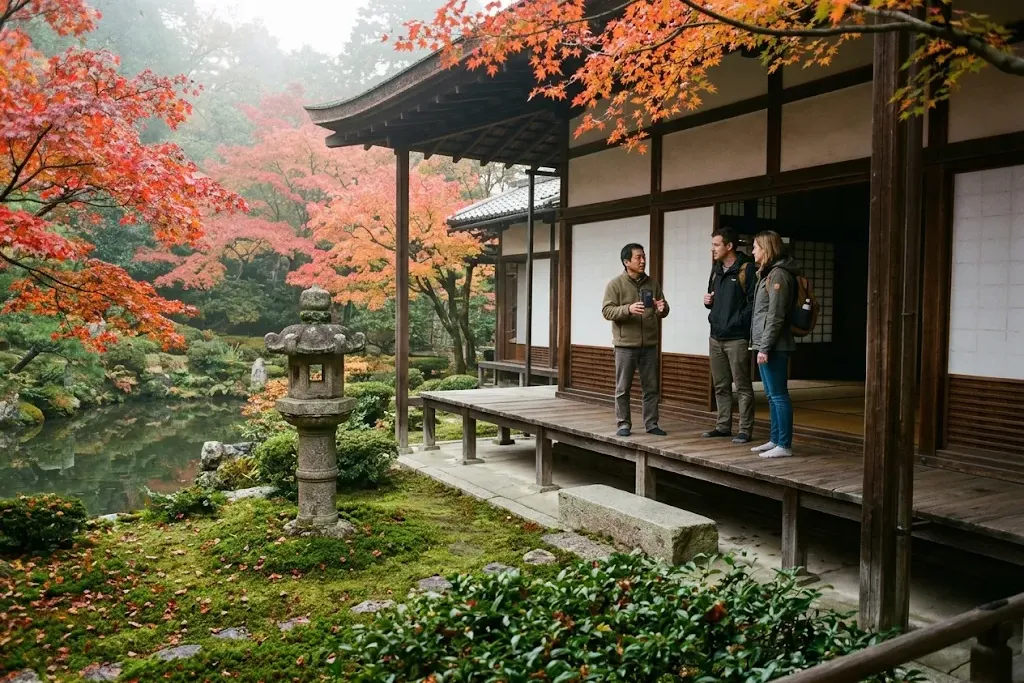
Since 2018, anyone in Japan may guide for pay; the national licensed guide interpreter qualification still exists and signals a guide who passed a demanding exam in history, culture and language. Either way, a local guide in Kyoto adds what's hard to find alone:
- Timing: which temple is calm at which hour, and which special openings (night illuminations, gardens open only in spring or autumn) are on during your visit.
- Context: reading a Zen garden, understanding what you're seeing at a shrine, and the history behind the lanes.
- Doors: tea ceremonies, craft workshops, sake breweries in Fushimi and meals that are hard to book without Japanese.
Practical notes
- Cash and cards: cards are widely accepted, but temples and small restaurants often take cash only.
- Temple etiquette: take your shoes off where shown, don't touch moss or walk on raked gravel, and keep voices low.
- Day trips: Nara (deer and Todai-ji) is 45 minutes by train; Uji (tea and Byodo-in) about 20 to 30 minutes.
The short version
- Plan three full days, four with a day trip.
- Go early in the day; spring blossom and late November are the busiest weeks.
- Expect the new accommodation tax at check-in, and keep out of Gion's closed private lanes.
- Use trains and the subway over buses.